
A Simple Guide to the Longevity Protein SIRT6 That Fights Aging and Guards Our Health
Longevity Protein SIRT6 is a big part of answer of how our cells manage to fix themselves after getting damaged, or why some people seem to age slower than others.
This hard-working protein inside our bodies, called SIRT6, is lately widely researched for its anti-aging benefits and potentially helps to longevity.
Scientists often call SIRT6 a “longevity protein” or a “master controller.”
Think of it as a combination of an expert mechanic, a strict security guard, and a dedicated night-shift janitor inside your cells.
Below is a clear, simple breakdown of what SIRT6 does, how it keeps us healthy, and why researchers are so excited about it.
The classic, highly cited 2008 paper that first established the catastrophic progeroid (premature aging) and hypoglycemic syndromes in mice lacking the SIRT6 gene.
This provides the historical and fundamental proof for why SIRT6 is dubbed the DNA repair, metabolism and ageing and is know as “longevity protein”.
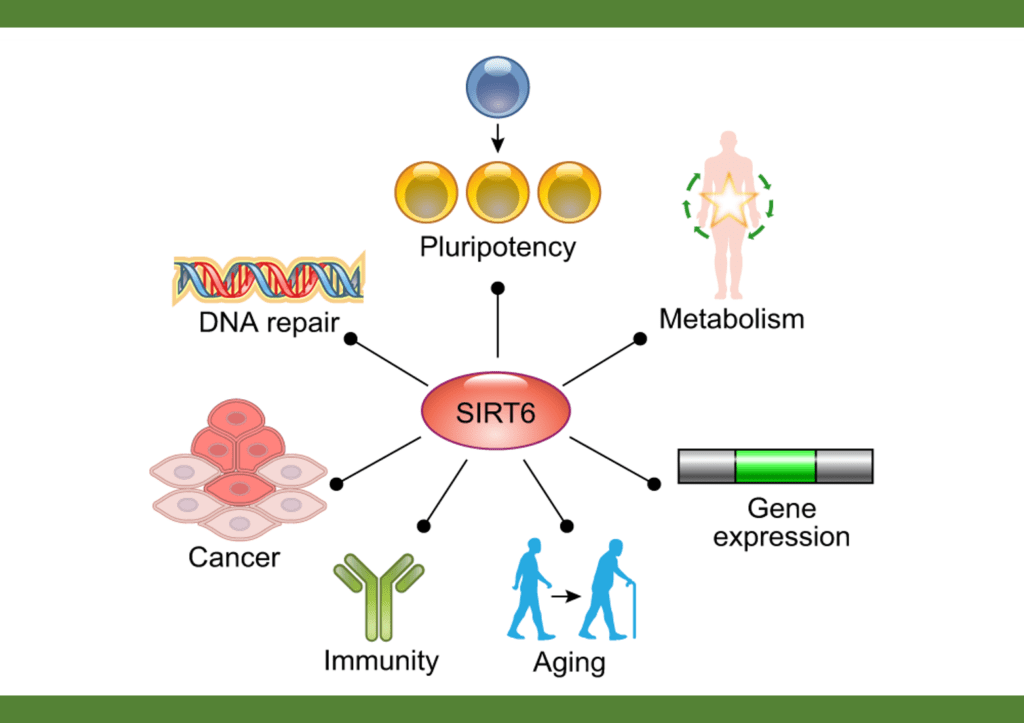
1. The Three Primary Jobs of SIRT6
SIRT6 is an enzyme, which means it is a specialized protein that triggers and speeds up vital chemical reactions. It uses three main cellular strategies to keep your systems running smoothly:
- The Chromatin Compactor (Deacetylation): Inside your cells, your DNA is wrapped around spool-like proteins called histones. SIRT6 removes tiny chemical tags called acetyl groups from these spools. This causes the DNA to tightly pack away, turning “off” specific genes that should not be active—such as the ones that trigger runaway inflammation.
- The Shipping Inspector (Defatty-Acylation): SIRT6 can slice long fatty chains off other proteins. This acts like a molecular shipping label, dictating whether the cell should secrete a protein into the body or keep it locked securely inside.
- The Emergency Flares (Mono-ADP-Ribosyltransferase): When a cell encounters severe environmental stress, SIRT6 hooks a single molecule onto target proteins. This serves as a cellular emergency flare, signaling heavy-duty repair crews to tackle immediate damage.
2. The Cellular Mechanic: Continuous DNA Repair
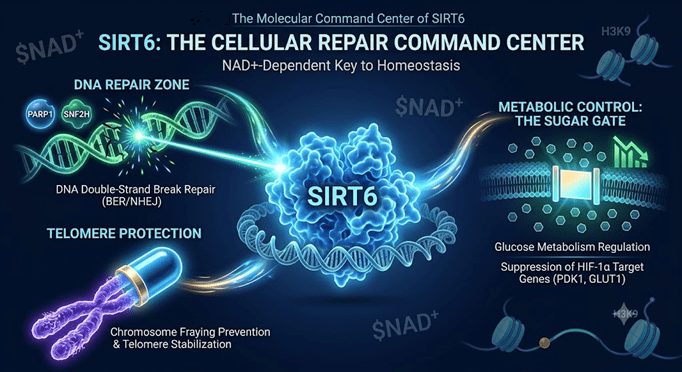
Every single day, your DNA is constantly bombarded and damaged by external factors like sunlight and pollution, as well as regular internal metabolic processes. If this damage is left unchecked, cells can mutate into cancer cells or die prematurely, driving rapid physical aging. SIRT6 acts as a first responder at the scene of dangerous DNA breaks:
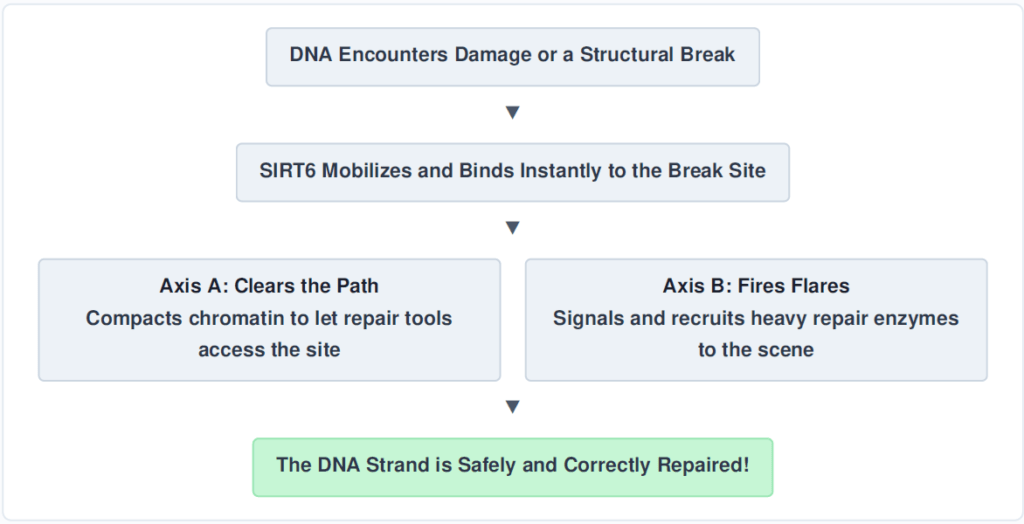
By clearing physical clutter out of the way and calling in the repair crew, SIRT6 ensures your genetic code remains structurally sound. Without it, your chromosomes begin to fray at their ends (called telomeres), much like the protective plastic tips on shoelaces. When those ends wear out, cells stop dividing permanently and age rapidly.
A recent 2025 computational and biochemical analysis detailing exactly how natural compounds (like flavonoids and quercetin) interact with the hydrophobic binding pocket of SIRT6. Therapeutic Perspectives of SIRT6 Regulation is perfect for readers looking for the real science behind the “Diet and Medicine” sections.
3. The Sugar Guard: Controlling Metabolism
To understand the profound real-world impact of this protein, scientists observed the health of animal models with altered SIRT6 levels:
| SIRT6 Genetic Status | Observed Cellular & Body Phenotypes |
| SIRT6 Missing (Knockout Models) | Mice develop normally for the first two weeks, but then experience a precipitous, life-threatening drop in blood sugar. They rapidly lose body fat, develop severely curved spines, lose protective immune cells, and pass away within a single month. |
| SIRT6 Boosted (Overexpression) | Genetically engineered mice that produce more SIRT6 than normal live significantly longer, healthier lives. They show delayed aging, robust blood sugar management, and their cells resist breakdown. |
4. SIRT6 in the Context of Serious Diseases
Because SIRT6 regulates core survival mechanisms, its activity directly influences how our bodies fight off major medical conditions. SIRT6 Widely Regulates Aging, Immunity, and Cancer.
The Cancer Paradox
In oncology, SIRT6 functions as a double-edged sword depending completely on the type of tumor involved:
- The Defender: In liver and colon cancers, SIRT6 acts as a powerful tumor suppressor. It keeps cells stable so they do not mutate and blocks them from eating the massive quantities of sugar they need to multiply rapidly.
- Conversely, in certain aggressive cancers like melanoma (skin cancer), tumor cells actually hijack SIRT6. They use its protective qualities to defend themselves against standard medical
treatments, making the cancer stronger and tougher to destroy.
Alzheimer’s Disease & Cognitive Health
When researchers analyze the brains of individuals with Alzheimer’s disease, they notice that SIRT6 levels are remarkably low.
Without adequate SIRT6, brain cells lose their primary line of defense against everyday DNA damage.
This causes neurons to become fragile and vulnerable, accelerating memory loss and cellular decline.
The following detailed paper specifically unpacks the “Cancer Paradox”—explaining exactly how the dual roles of SIRT6 in cancer biology switches from a tumor suppressor to a tumor promoter depending on the metabolic context and the specific tissue type.
5. Can We Activate SIRT6 via Diet or Medicine?
Because increasing SIRT6 can promote healthy longevity, researchers are actively searching for molecules that can flick its therapeutic “ON” switch. They have discovered that specific natural plant compounds called flavonoids can modulate how the enzyme behaves:
- SIRT6 Activators: Natural compounds such as isoquercetin (found in apples and onions) and luteolin (found in celery and chamomile) can give SIRT6 a helpful boost. Scientists are actively testing these to see if they can aid in managing type 2 diabetes and metabolic decline.
- SIRT6 Inhibitors: Other compounds can purposefully slow SIRT6 down. While that sounds counterintuitive, it is incredibly useful for oncology. If a doctor is treating an aggressive melanoma that is using SIRT6 as a shield, an inhibitor can drop the cancer’s defenses, so therapy works effectively.
The Quercetin Twist: The common dietary supplement quercetin behaves like a molecular trickster. In small doses, it can help activate SIRT6, but at high doses, it can flip entirely and turn the protein off. This unpredictable nature is why researchers are focused on engineering precise, laboratory-validated medicines rather than relying on raw dietary supplements.
Frequently Asked Questions (FAQ)
References
Akter, R., Afrose, A., Rahman, M. R., Chowdhury, R., Nirzhor, S. S. R., Khan, R. I., & Kabir, M. T. (2021). A comprehensive analysis into the therapeutic application of natural products as SIRT6 modulators in Alzheimer’s disease, aging, cancer, inflammation, and diabetes. International Journal of Molecular Sciences, 22(8), 4180.
Anaya Aldrete, K. (2026). Mechanisms of the antiproliferative effects of SIRT6 inhibition in melanoma: A multi-omics analysis. MDPI.
de Carvalho Matias, É. G. (2025). Therapeutic perspectives of SIRT6 regulation: Computational analysis of activation and inhibition by bioactive molecules. PMC.
Li, Y., Jin, J., & Wang, Y. (2022). SIRT6 widely regulates aging, immunity, and cancer. Frontiers in Oncology, 12, 861334.
Lombard, D. B., Schwer, B., Alt, F. W., & Mostoslavsky, R. (2008). SIRT6 in DNA repair, metabolism and ageing. Journal of Internal Medicine, 263(2), 128-141.
Lu, K., Yu, S., Sun, D., Xing, H., An, J., Kong, C., Yu, M., & Zhu, Y. (2018). Scientometric analysis of SIRT6 studies. Medical Science Monitor, 24, 8357-8371.
Meng, F., Qian, M., Peng, B., Peng, L., Wang, X., Zheng, K., Liu, Z., Tang, X., Zhang, S., Sun, S., Cao, X., Pang, Q., Zhao, B., Ma, W., Songyang, Z., Xu, B., Zhu, W. G., Xu, X., & Liu, B. (2020). Synergy between SIRT1 and SIRT6 helps recognize DNA breaks and potentiates the DNA damage response and repair in humans and mice. eLife, 9.