
Stop Guessing. Start Losing. The Real Science of a Calorie Deficit.
Every time you embark on a weight loss journey, you’re hit with an overwhelming amount of noise: “one-weird-trick” diets, conflicting macro advice, and impossible promises.
It’s time to silence the chaos and master the one truth that works: achieving a Realistic Calorie Deficit – the only evidence-based path to sustainable results.
You’ve heard about “magic” superfoods, “hormone-blocking” supplements, and “one-weird-trick” diets that promise to melt fat overnight. These claims are confusing, contradictory, and, in almost all cases, scientifically baseless.
At the core of this noise is a deliberate attempt to hide the simple, unchanging principle of weight loss. Why? Because the simple truth is hard to package, brand, and sell.
This article is your antidote to that noise.
We are going to give you the unvarnished, evidence-based truth. The mechanism of fat loss is not a mystery; it’s a well-understood law of physics.
The real challenge isn’t in understanding the science—it’s in applying it in a way that is realistic, sustainable, and respectful of your body’s biology.
Welcome to the definitive guide on the calorie deficit.
Part 1: The Non-Negotiable Law of Energy Balance Realistic Calorie Deficit
Before we discuss anything else—protein, carbs, meal timing, or exercise—we must start here. The only way for the human body to lose fat mass is to create a calorie deficit.
Achieving realistic calorie deficit is the most critical factor for sustainable weight loss, yet it is often misunderstood.
Many popular diets encourage aggressive cuts—sometimes 1,000 calories or more per day—which are neither realistic calorie deficit goals nor metabolically healthy.
Such drastic reductions lead to intense hunger, nutrient deficiencies, and metabolic slowdown, making compliance impossible
This isn’t a theory or a “diet trend.” It’s the First Law of Thermodynamics, also known as the law of energy conservation.
- A calorie is simply a unit of energy.
- Your body requires energy (calories) to function.
- You provide this energy through food and drink (Energy In).
- Your body expends this energy to stay alive, move, digest, and think (Energy Out).
The relationship between these two sides of the equation dictates your weight:
- Energy In = Energy Out: You are in energy balance. Your weight remains stable.
- Energy In > Energy Out: You are in a calorie surplus. Your body stores the extra energy, primarily as body fat. Your weight increases.
- Energy In < Energy Out: You are in a calorie deficit. Your body must find energy from its own reserves to make up the difference, primarily by metabolizing stored body fat. Your weight decreases.
Any diet, from Keto to Paleo to Weight Watchers, that results in weight loss does so by (often sneakily) getting you to create a calorie deficit. They are simply different methods for achieving the same non-negotiable outcome.
Part 2: The “Energy Out” Myth: Your Metabolism is Not One Thing
Here is where most fad diets fail. They treat “Energy Out”—your metabolism—as a single, mysterious black box. It’s not.
Your “Energy Out” is your Total Daily Energy Expenditure (TDEE), and it’s made of four distinct components. Understanding this is the key to creating a deficit that doesn’t feel like a punishment.
- Basal Metabolic Rate (BMR):
- What it is: The energy your body burns at complete rest just to stay alive—think breathing, brain function, heart beating, and cell production.
- Its Impact: This is the largest piece of your metabolic pie, accounting for 60-70% of your total daily burn. You cannot “boost” this in any meaningful way, but a crash diet can cause it to slow down as a survival mechanism.
- Thermic Effect of Food (TEF):
- What it is: The energy your body uses to digest, absorb, and metabolize the food you eat.
- Its Impact: This accounts for about 10% of your TDEE. Interestingly, not all food is created equal here. Protein has the highest TEF, meaning your body burns more calories processing it (20-30%) than it does for carbs (5-15%) or fats (0-5%).
- Exercise Activity Thermogenesis (EAT):
- What it is: This is the “gym” part—the energy you burn during intentional, structured exercise like running, lifting weights, or taking a spin class.
- Its Impact: For most people, this is a surprisingly small part of your TDEE, often only 5-15%. This is why the “you can’t outrun a bad diet” saying is true. It is incredibly difficult to create a meaningful deficit only through exercise.
- Non-Exercise Activity Thermogenesis (NEAT):
- What it is: This is the hidden secret weapon of metabolism. It’s all the movement you do that isn’t formal exercise: walking to your car, taking the stairs, fidgeting, doing chores, even maintaining posture.
- Its Impact: This is the most variable component and the one most under your control. It can account for 15% or more of your TDEE and is the single biggest factor separating a “sedentary” person from an “active” one, even if neither goes to the gym.
Why This Matters: When you adopt an aggressive crash diet, your body fights back. Your BMR may slow slightly, but the biggest hit is to your NEAT. You unconsciously move less. You feel lethargic, so you take the elevator. You fidget less. You slouch. Your body cleverly reduces your “Energy Out” to close the deficit gap, your weight loss stalls, and you blame your “willpower.”
Part 3: The Perils of “Fast” vs. The Power of “Realistic”
The weight loss industry sells speed. We’re here to sell you sustainability. A realistic deficit is scientifically superior to an aggressive one for long-term fat loss.
Let’s do the math. One pound of body fat contains approximately 3,500 calories of stored energy.
- To lose 1 pound per week, you need a total weekly deficit of 3,500 calories. This averages out to a 500-calorie deficit per day.
- To lose 2 pounds per week, you need a 1,000-calorie deficit per day.
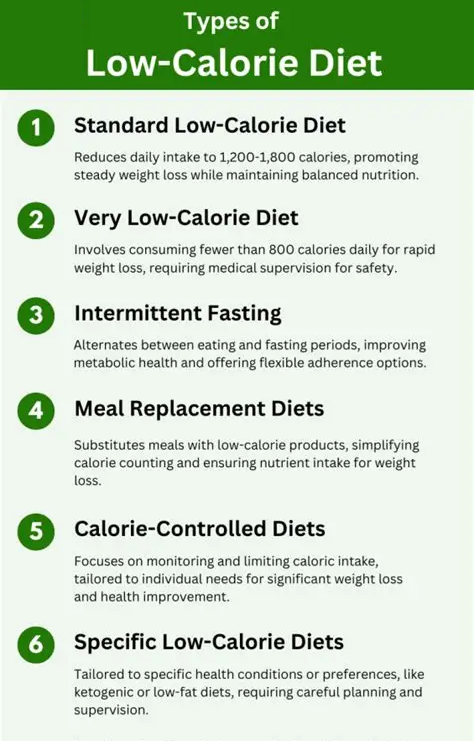
- Standard Low-Calorie Diet: Reduces daily intake to 1,200–1,800 calories, promoting steady weight loss while maintaining balanced nutrition.
- Very Low-Calorie Diet: Involves consuming fewer than 800 calories daily for rapid weight loss, requiring medical supervision for safety.
- Intermittent Fasting: Alternates between eating and fasting periods, improving metabolic health and offering flexible adherence options.
- Meal Replacement Diets: Substitutes meals with low-calorie products, simplifying calorie counting and ensuring nutrient intake for weight loss.
- Calorie-Controlled Diets: Focuses on monitoring and limiting caloric intake, tailored to individual needs for significant weight loss and health improvement.
- Specific Low-Calorie Diets: Tailored to specific health conditions or preferences, like ketogenic or low-fat diets, requiring careful planning and supervision.
The CDC and other major health institutions recommend a safe, sustainable rate of 1 to 2 pounds per week. For most people, a 1,000-calorie deficit is already pushing the boundary of “aggressive.”
The practical challenge, then, lies in executing this realistic calorie deficit without relying on extreme willpower.
This is where behavioral strategies, like habit stacking, become invaluable. Instead of counting every single calorie, which is often tedious and inaccurate, we automate small, low-friction habits that naturally minimize intake and increase expenditure.
Here is what happens in an aggressive deficit (e.g., cutting 1,200 calories or eating a flat 1,200-calorie diet):
- You Lose Muscle, Not Just Fat: When energy is too scarce, your body breaks down metabolically active muscle tissue for fuel. This lowers your BMR and makes you “skinnier” but not healthier.
- You Suffer from Nutrient Deficiencies: It is nearly impossible to get all your essential vitamins, minerals, and fiber on a severely restricted diet, leading to hair loss, brittle nails, and poor immune function.
- You Trigger “Metabolic Adaptation”: As seen in the landmark “Minnesota Starvation Study,” the body adapts to severe restriction. Your body temperature drops, you become obsessed with food, and your metabolism (BMR + NEAT) plummets in a desperate attempt to conserve energy.
- You Create a Psychological Boomerang: This is the “binge-restrict” cycle. You use all your willpower to “be good” for five days, only to have your biology override you in a “binge” on the weekend, wiping out your entire deficit. This isn’t a failure of you; it’s a predictable failure of the plan.
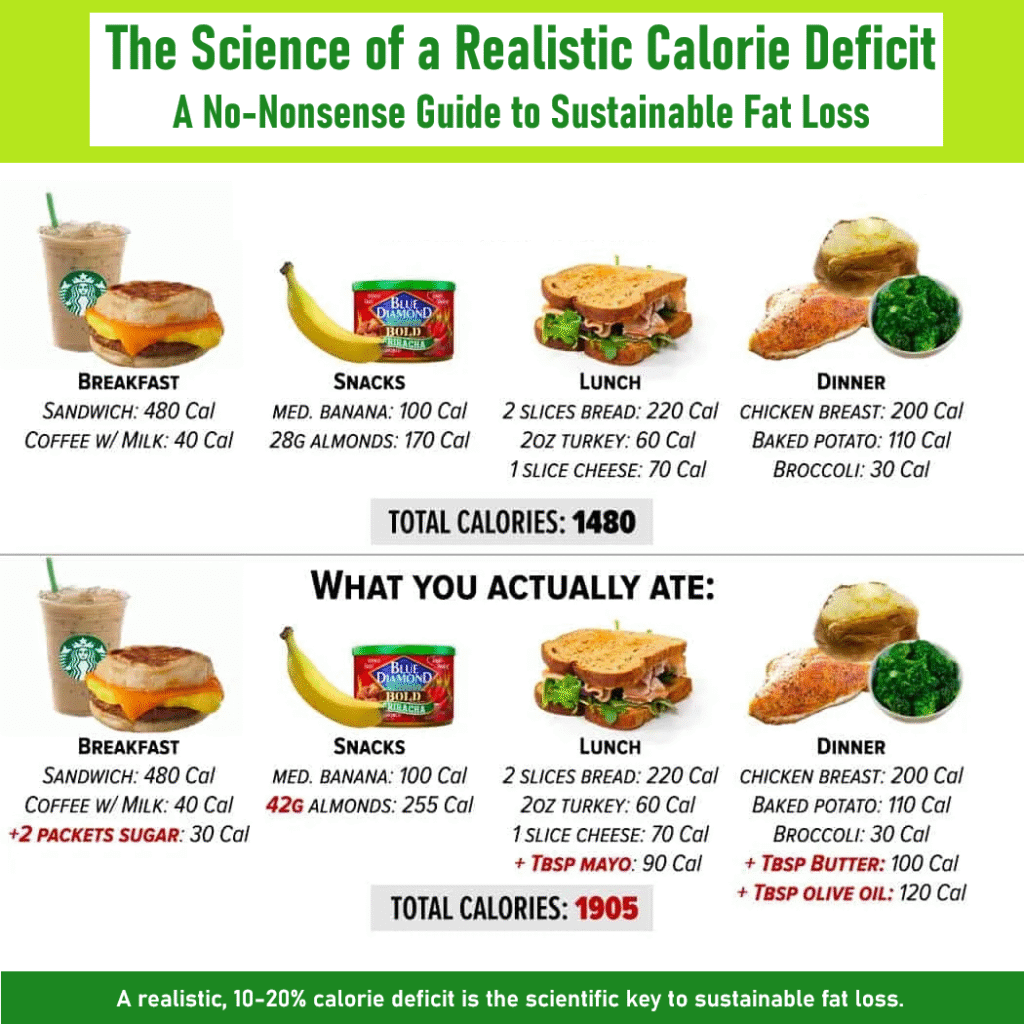
A realistic calorie deficit (10-20% below your TDEE) is the goal. It is slow. It is sometimes boring. And it works, because it targets fat while preserving muscle, keeps you nourished, and prevents the biological panic response.
Simple acts like substituting a high-calorie drink with water or adding a short walk after a meal can cumulatively create the necessary realistic calorie deficit over the course of a week.
These tiny, automated actions ensure the deficit is managed consistently, protecting you from the all-or-nothing mindset that causes most long-term diet failures.
Part 4: How to Calculate a Sustainable Deficit (The Professional Method)
Forget the “eat 1,200 calories” one-size-fits-all nonsense. Here is the 3-step professional method.
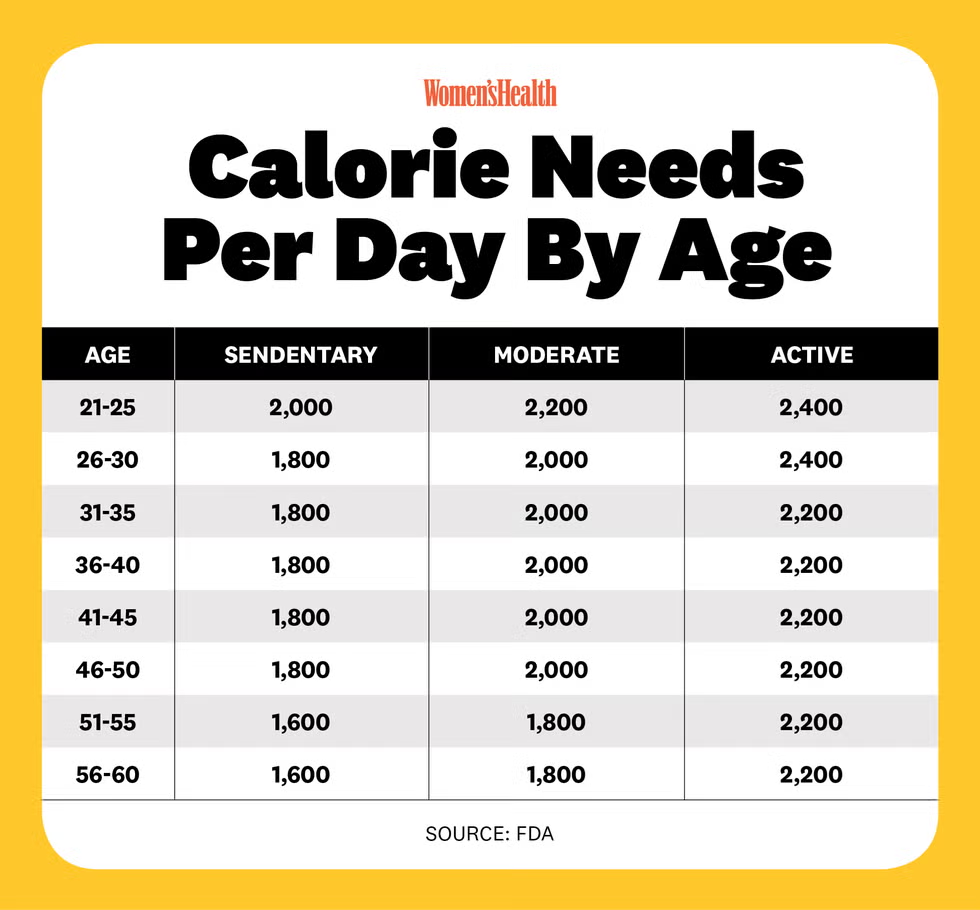
Step 1: Estimate Your TDEE (Your “Maintenance” Calories) You can get a rough estimate using a TDEE calculator online. We recommend one that uses the Mifflin-St Jeor equation, which studies have shown to be the most accurate for the general population. This will give you a starting hypothesis based on your age, sex, height, weight, and activity level.
Step 2: Be Transparent: This Is an Estimate This is a critical trust point. No online calculator can perfectly know your unique genetics, office environment, and daily habits. The only way to find your true TDEE is to:
- Eat at your estimated TDEE for 2-3 weeks.
- Track your weight.
- If your weight stays the same, you’ve found your true maintenance. If it goes up or down, adjust your intake by 100-200 calories and repeat.
Step 3: Apply a Sustainable, Percentage-Based Deficit Once you have your true maintenance TDEE, do not just slash 1,000 calories. Apply a sane, sustainable percentage.
- Realistic Deficit (Recommended): 10-20%
- Example: Your TDEE is 2,500 calories.
- A 15% deficit is 375 calories (2500 x 0.15).
- Your new target is 2,125 calories per day.
- Aggressive Deficit (Not Recommended): 25%+
A Note on Calorie “Floors”: As a matter of health and safety, it is not recommended for women to eat below 1,200 calories or for men to eat below 1,500 calories for any extended period without direct medical supervision.
Part 5: Beyond the Numbers: Why Food Quality Makes the Deficit Feel Realistic
Is a calorie just a calorie?
When designing your long-term plan, always prioritize setting a realistic calorie deficit that aligns with your lifestyle, not one that aligns with temporary, aspirational goals.
If your deficit makes you feel constantly irritable, exhausted, or unable to focus, it is not realistic, and it is setting you up for failure.
A well-designed, realistic calorie deficit allows for flexibility, social eating, and occasional indulgence without compromising your progress.
This balanced approach guarantees you remain on track for years, making maintenance the effortless continuation of your established lifestyle, rather than a separate, difficult phase of dieting.
- For weight loss? Yes. 500 calories of donuts and 500 calories of chicken breast will create the same thermodynamic deficit.
- For adherence and health? Absolutely not.
Focusing on food quality is what makes sticking to the quantity possible. Here’s why:
- Satiety (Fullness): 500 calories of donuts will be digested rapidly, spike your blood sugar, and leave you hungry again in an hour. 500 calories of chicken breast, broccoli, and quinoa is high in protein and fiber. These nutrients are digested slowly and send powerful “I am full” signals to your brain, making the deficit feel effortless.
- The Thermic Effect (TEF): As mentioned in Part 2, your body burns 20-30% of the calories from protein just to digest it. This means a high-protein diet gives you a small, free metabolic advantage every single day.
- Volume (Volumetrics): 100 calories of spinach is a massive bowl. 100 calories of olive oil is one small spoonful. By focusing on high-volume, low-density foods (like fruits, vegetables, and lean proteins), you can eat more food and feel physically full while still maintaining your deficit.
Our “TrustHub” Pledge
This is our commitment to you. We will never tell you:
- That you need to buy a specific supplement or “superfood.”
- That you must eliminate entire food groups (unless for a medical reason).
- That this is a test of your willpower. If you are struggling, the plan is failing you, not the other way around.
- That you must be 100% “perfect.” A sustainable plan has room for a piece of cake. It’s about your average intake over the week, not one “bad” meal.
The takeaway is simple: A realistic, 10-20% calorie deficit is the scientific key to sustainable fat loss.
Safe & Sustainable Deficit is the only way to seek according to the NIH recommendation, for a realistic calorie deficit.
You achieve it by first understanding your TDEE, and you maintain it by prioritizing foods that keep you full, nourished, and energized—like protein and fiber.
This is a long-term process of building a system that works for your body, not a short-term race to a number on the scale.