
If you are beginning your treatment journey, understanding the biological link between GLP-1 medication and GI side effects is the first step toward reclaiming your comfort and ensuring long-term success.
Table of Contents
The arrival of semaglutide and tirzepatide has fundamentally changed the landscape of metabolic health and weight management. However, for many patients, the path to improved health is interrupted by a trio of digestive disruptions.
If you are beginning your treatment journey, understanding the biological link between GLP-1 medication and GI side effects is the first step toward reclaiming your comfort and ensuring long-term success.
Whether you are dealing with a stomach that feels like it’s full of lead or “sulfur burps” that make social situations awkward, these symptoms are manageable.
This guide dives deep into why these issues occur and provides a science-backed roadmap for managing the most common hurdles of GLP-1 medication and GI side effects.
Why Does GLP-1 Medication Cause GI Side Effects?
To fix the problem, we have to understand the science. GLP-1 (glucagon-like peptide-1) is a hormone your body naturally produces to signal fullness. These medications mimic that hormone but at much higher, sustained levels.
The primary way they work is by inducing delayed gastric emptying. This means food stays in your stomach significantly longer than it used to.
While this is excellent for making you feel full on small portions, it is the primary culprit behind GLP-1 medication and GI side effects.
Clinical trials published in the New England Journal of Medicine confirm that while weight loss results are significant, gastrointestinal events remain the most frequent reason for treatment adjustments.
When food sits in the stomach too long, it can ferment (leading to bloating), cause acid reflux, and send signals to your brain that something is “wrong,” resulting in persistent nausea.
Essentially, managing GLP-1 medication and GI side effects requires acknowledging that your digestive timeline has been intentionally slowed.
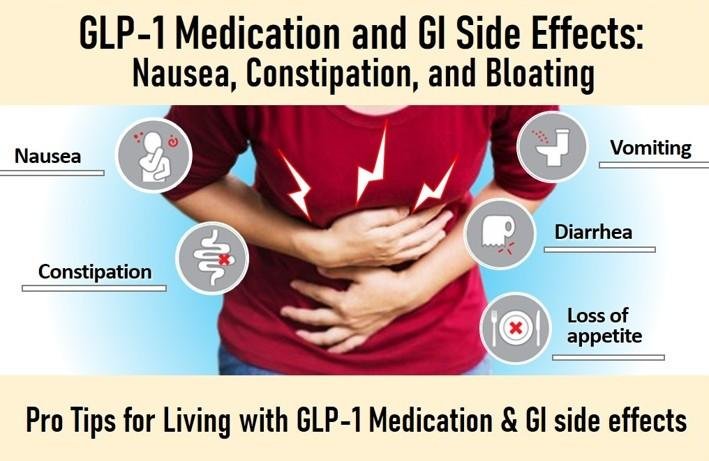
1. Navigating the Waves of Nausea
Nausea is the most commonly reported side effect, affecting nearly 40% of patients. It usually peaks 24–48 hours after your injection.
If you want to maintain your treatment schedule, mastering this aspect of GLP-1 medication and GI side effects is non-negotiable.
The “Small and Often” Strategy
When your stomach is moving at a snail’s pace, a large meal is an anatomical nightmare.
The best way to combat nausea from GLP-1 medication and GI side effects is to switch to “grazing” mode.
Eat five or six tiny meals rather than two large ones.
This prevents the stomach from becoming over-distended, which is a major trigger for vomiting.
Avoid the “Grease Trap”
High-fat, fried, or heavily processed foods take even longer to digest.
If you combine a slow-moving stomach with a greasy cheeseburger, that fat is going to sit there and oxidize, making you feel incredibly ill.
To minimize GLP-1 medication and GI side effects, stick to “bland” but nutrient-dense foods like Greek yogurt, protein shakes, or grilled chicken during your “nausea window.”
Hydration with a Kick
Sipping on ginger tea or peppermint tea can provide immediate relief. Natural prokinetics like ginger help move the stomach along.
If the nausea is debilitating, talk to your doctor about a temporary prescription for Zofran (ondansetron), though be warned: Zofran is notorious for causing the next issue on our list of GLP-1 medication and GI side effects.
2. The Great Standstill: Managing Constipation
If nausea is the “loud” side effect, constipation is the “heavy” one.
Because GLP-1s slow down the wave-like muscle contractions (peristalsis) of the entire digestive tract, things can get backed up quickly.
This is one of the more persistent types of GLP-1 medication and GI side effects because it can lead to long-term discomfort if left unaddressed.
Fiber is Your Best Friend (But Be Careful)
You need fiber to move things along, but adding a massive amount of raw kale to a slow gut can actually cause more bloating.
When dealing with GLP-1 medication and GI side effects, focus on soluble fiber like psyllium husk or softened, well-cooked vegetables. Avoid raw, cruciferous veggies if you are already feeling “stopped up.”
The Magnesium Secret
Many patients find success by taking Magnesium Citrate or Magnesium Oxide before bed.
It draws water into the colon, making stools easier to pass. It’s a gentler alternative to harsh stimulant laxatives and a highly effective way to mitigate GLP-1 medication and GI side effects involving the lower GI tract.
Water, Water, Everywhere
The GLP-1 molecule actually suppresses your thirst signals along with your hunger signals.
You might be dehydrated without even realizing it. Aim for 80–100 ounces of water daily.
If your stool doesn’t have enough water to move, it’s going to stay exactly where it is, exacerbating your GLP-1 medication and GI side effects.

3. Beating the Bloat and “Sulfur Burps”
Perhaps the most embarrassing side effect of GLP-1 medication and GI side effects is the bloating and the dreaded “sulfur burps.”
This happens because food—especially protein—is sitting in the stomach so long it begins to break down and release hydrogen sulfide gas.
Digestive Enzymes: Your Secret Weapon
Taking a broad-spectrum digestive enzyme before your largest meal can help your body break down proteins and fats faster.
This reduces the amount of gas produced in the stomach, effectively lowering the severity of GLP-1 medication and GI side effects like distention and foul-smelling gas.
Watch the Bubbles
If you’re already bloated, stop drinking carbonated water and soda. You’re just adding gas to a closed system.
Stick to still water until the bloating subsides. When you are managing GLP-1 medication and GI side effects, simplicity in your beverage choice is key.
Movement as Medicine
Never lie down immediately after eating. A 15-minute walk after eating can stimulate the muscles in your GI tract to keep things moving.
Gravity and movement are your two greatest allies against the localized pressure of GLP-1 medication and GI side effects.
When Should You Be Worried?
While we expect a certain level of GLP-1 medication and GI side effects, there are red flags you shouldn’t ignore.
If you experience severe, “wrap-around” abdominal pain (potential pancreatitis), persistent vomiting where you can’t keep liquids down, or no bowel movement for more than 5 days, contact your healthcare provider immediately.
Safety should always come before weight loss goals when managing GLP-1 medication and GI side effects.
It is crucial to distinguish between common discomfort and serious complications like pancreatitis; for a full list of clinical symptoms that require urgent care, refer to the Mayo Clinic’s guide on digestive health.
Navigating the Dose Escalation
Most people experience a spike in GI side effects of GLP-1 medication every time they increase their dosage.
This is normal. If the side effects become unbearable, talk to your doctor about staying at your current dose for an extra month.
There is no prize for reaching the “maximum” dose quickly; the goal is sustainable weight loss without misery.
When to Seek Help
While we expect some GI side effects of GLP-1 medication, you should call a doctor if you experience:
- Persistent, projectile vomiting.
- Severe pain in the upper right or center of your abdomen.
- Fever or chills accompanying stomach pain.
FAQ: Managing Your Journey
Conclusion: Perspective on the Progress
Living with GLP-1 medication and GI side effects is a trade-off for most. And, managing GI side effects that GLP-1 medication bring, is undeniably a challenge.
However, for many, it is a small price to pay for the profound health transformations these drugs offer.
By adjusting your eating habits, prioritizing hydration, and using supplements like magnesium and digestive enzymes, you can successfully navigate these waters.
The metabolic benefits usually far outweigh a few weeks of nausea or bloating.
Adjusting your portion sizes, prioritizing hydration, with smart supplementation will help you quiet the “gut noise” and focus on your health transformation.
Remember, your body is undergoing a massive hormonal shift. Give it grace, give it water, and give it time to adapt to your GLP-1 medication and GI side effects.
Don’t let the initial “gut turbulence” discourage you.
With a proactive approach and a bit of patience, you can master the management of GI side effects of GLP-1 medication and focus on your long-term health and wellness.
While managing digestive comfort is essential, it is only one part of a successful treatment plan; for a complete look at long-term strategies, dosage charts, and lifestyle integration, visit our Comprehensive Guide to GLP-1 Success.”