
Weight Loss & Cortisol: Stop Stress, Unlock Secret of Weight Loss
1. Introduction: The Invisible Weight Loss Roadblock
Cortisol Weight Loss Connection is something that you should pay attention to.
If you are eating well, exercising consistently, and yet the scale won’t budge—or worse, a stubborn layer of fat seems to be accumulating exclusively around your midsection.
This frustrating phenomenon often has little to do with willpower and everything to do with a powerful, hidden actor: cortisol, the body’s primary stress hormone.
In an industry overflowing with restrictive diets, the scientific methodology cuts through the noise. We acknowledge that sustained health requires addressing the complex hormonal environment.
This simple but practical guide will provide a deep dive into the Cortisol Connection, explaining how chronic stress short-circuits your metabolism and providing science-backed strategies to regain hormonal balance and unlock genuine, sustainable hormonal weight loss.
2. Understanding Cortisol: Weight loss Hormone
Cortisol is essential for life, produced by the adrenal glands as part of the Hypothalamic-Pituitary-Adrenal (HPA) axis. Its function is to manage the “fight-or-flight” response to acute stress (like escaping danger). When cortisol spikes, it instantly:
- Increases heart rate and blood pressure.
- Floods the bloodstream with glucose (energy).
- Suppresses non-essential functions, like digestion and the immune system.
The Problem of Chronic Stress
The critical issue in modern life is that the body cannot distinguish between the acute stress of a predator and the chronic stress of a demanding job, financial worries, or relationship tension. Constant emails, traffic, and poor sleep keep the HPA axis stuck in the “on” position, leading to persistently elevated cortisol. This state of chronic stress is where the metabolic damage begins.
Fight-or-Flight and the Belly Fat Paradox
Chronic high cortisol is directly linked to the accumulation of central obesity (visceral fat). The evolutionary rationale is simple: when stress is chronic (e.g., famine or danger), the body conserves the most metabolically available energy source—fat—and stores it close to the vital organs for quick deployment.
Research consistently shows that elevated cortisol promotes the storage of fat specifically in the abdominal area, even in lean individuals.
This distinct “Hormonal Belly” is more than cosmetic; visceral fat is metabolically active and releases inflammatory chemicals, further fueling the cycle of chronic inflammation and metabolic slowdown.
3. The Cortisol-Appetite Feedback Loop
Cortisol doesn’t just encourage fat storage; it actively sabotages your efforts to eat healthily by hijacking your appetite-regulating hormones: Ghrelin (the hunger hormone) and Leptin (the satiety hormone).
Cortisol, Hunger, and Cravings
When cortisol levels are high, the body’s demand for high-energy fuel skyrockets, leading to intense reward-driven eating behaviors.
- Ghrelin Spike: Cortisol is known to stimulate the release of Ghrelin, increasing feelings of hunger and dramatically boosting your appetite.
- Leptin Resistance: Chronically elevated cortisol contributes to leptin resistance. The body stops correctly receiving the “I’m full” signal, leading to constant overconsumption, particularly of highly palatable, energy-dense foods (sugar and fat).
This vicious cycle is why, under stress, you are more likely to crave processed sweets and simple carbohydrates rather than nutrient-dense whole foods—it’s a primal, hormonal response that your Stress Management Weight Loss plan must counteract.
4. Diagnosing Your Hormonal Belly
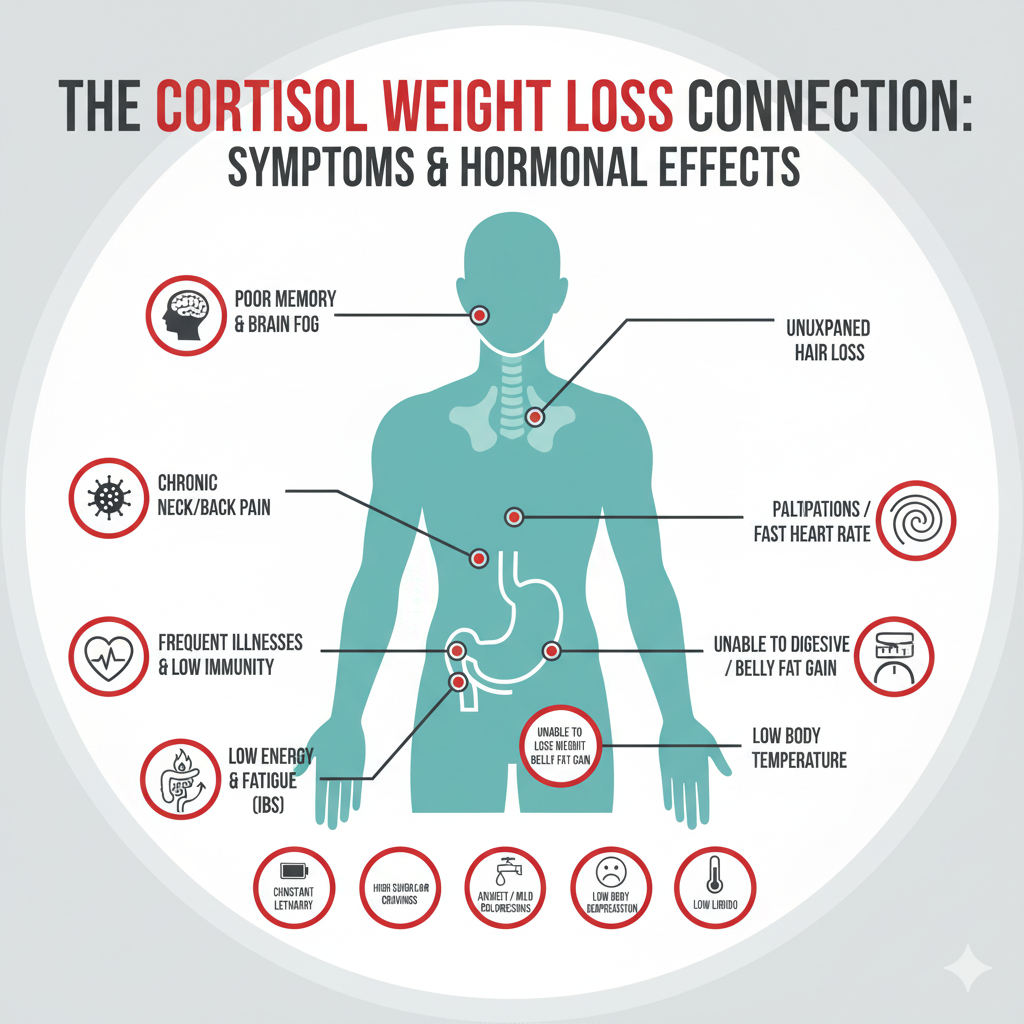
Identifying stress-related weight requires looking beyond the scale. If you check any of the following, your cortisol levels may be driving your weight struggles:
Is It Just Fat, or Is It Hormonal Belly?
The primary differentiator is location and texture. Cortisol-driven fat tends to be deep, firm, and centrally located, often extending to the back (“love handles”). It typically resists diet and exercise efforts that successfully reduce fat elsewhere on the body.
The Gut-Brain Axis: Cortisol’s Impact on Digestion
The gut and the brain are intimately connected via the Gut-Brain Axis. Chronic stress, mediated by cortisol, suppresses the parasympathetic nervous system (the “rest and digest” state). This can lead to:
- Bloating and Irregularity: Impaired digestion, nutrient malabsorption, and altered gut microbiome composition.
- Reduced Metabolism: If the body is diverting energy away from digestion and repair, metabolic processes slow down, cementing the metabolic slowdown cycle.
5. Science-Backed Strategies for Managing Cortisol
Achieving true hormonal weight loss means fundamentally changing your relationship with stress. Here are three powerful, evidence-based strategies to modulate the HPA axis:
Behavioral Coaching: Stress Reduction Techniques That Work
The goal is to intentionally activate the parasympathetic nervous system (rest and digest). Simple, consistent techniques can re-wire the stress response:
- Mindfulness and Meditation: Even five minutes daily can reduce perceived stress and measurable cortisol levels.
- Deep Diaphragmatic Breathing: Controlled, slow breathing exercises (e.g., 4-7-8 method) are proven to immediately calm the nervous system and lower cortisol.
- Nature Exposure: Spending time outdoors reduces psychological distress and has been linked to lower levels of the stress hormone.
Sleep is Non-Negotiable: Resetting Your Circadian Rhythm
Poor sleep is one of the fastest ways to spike cortisol. Cortisol naturally follows a circadian rhythm, peaking in the morning to wake you up and slowly dropping throughout the day. Chronic sleep issues (insomnia, late nights) disrupt this rhythm.
- Prioritize 7-9 hours of Quality Sleep: This is the most powerful natural reset for the HPA axis. Even partial sleep restriction increases evening cortisol levels.
- Establish a Pre-Bed Routine: Dimming lights, avoiding screens, and performing relaxation techniques signal to the body that the stress response can be turned off.
Nutritional Support: Foods That Naturally Lower Stress Hormones
While diet won’t eliminate severe stress, specific nutrients and compounds are vital for cortisol metabolism and adrenal support:
- Magnesium: Known as “nature’s tranquilizer,” it helps regulate the nervous system and is often depleted by chronic stress. Sources include dark leafy greens, seeds, and dark chocolate.
- Vitamin C: Found in bell peppers and citrus, Vitamin C is concentrated in the adrenal glands and helps regulate the cortisol response.
- Omega-3 Fatty Acids: Found in fatty fish, these acids are powerful anti-inflammatories that help reduce the overall inflammatory burden driven by high cortisol.
- Adaptogens: These specialized herbs—like Ashwagandha and Rhodiola Rosea—have been clinically shown to support the adrenal glands, helping the body resist the damaging effects of chronic stress and modulate cortisol production.
6. Conclusion: Making Peace with Stress for Sustainable Weight Loss
The Cortisol Connection proves that weight loss is not merely a calories-in, calories-out equation; it is a complex, hormonal conversation. By moving away from restrictive diet culture and integrating Stress Management Weight Loss strategies, you can normalize the hormonal environment, silence the intense cravings, and finally shift that stubborn abdominal fat.
The science is clear: sustainable, healthy weight requires a holistic approach that respects the power of the mind-body axis.
Ready to stop fighting your body and start managing your stress with evidence?