
Weight loss maintenance after stopping Mounjaro explained with a clinical exit strategy to manage food noise, protect muscle, and prevent rebound weight gain.
Expert Review: The Vetting Process

Expertly Curated by Phyllis Leonard
Focus: Metabolic Transition & GLP-1 Longevity
Phyllis Leonard has dedicated her 2025 research to the “Post-Tirzepatide Window,” recognizing that weight loss maintenance after stopping Mounjaro is the most critical phase of the journey. By auditing clinical data, Phyllis ensures that strategies for biological weight stability after tirzepatide are rooted in biology, not just willpower. Her curation of this guide focuses on bridging the gap between clinical medication and a permanent metabolic “soft landing.”
“My goal is to ensure that weight loss maintenance after stopping Mounjaro isn’t a source of anxiety, but a structured clinical victory.” — Phyllis Leonard
Table of Contents
While the weight loss journey itself is transformative, the ‘Mounjaro Rebound’—the clinical fear of rapid regain—remains the single most searched-for concern in the GLP-1 community.
Successfully navigating weight loss maintenance after stopping Mounjaro requires shifting your focus from the scale to your underlying metabolic biology.
Without a biological roadmap, the return of “food noise” can feel like an impossible wave to fight.
“Mounjaro rebound,” “food noise returning,” and “weight gain after stopping tirzepatide” dominate search queries for a good reason. While Mounjaro (tirzepatide) can be transformative for weight loss, the real challenge begins after the final injection.

Weight loss maintenance after stopping Mounjaro is not about willpower. It is about biology, muscle preservation, appetite signaling, and metabolic planning. Without a structured exit strategy, the body often defaults back to its pre-medication set point.
The SURMOUNT-4 Clinical Trial (JAMA) This is the “Gold Standard” study regarding weight regain after tirzepatide. It proves that without a plan, patients regained about 14% of their weight. JAMA: Continued Treatment With Tirzepatide for Maintenance of Weight Reduction
This guide outlines a clinically grounded, experience-tested exit framework—the same principles used by obesity specialists, metabolic clinics, and long-term GLP-1 users who maintain their results.
Product links in this guide are included to support readers during the post-GLP-1 transition. Recommendations are based on clinical relevance and real-world usability—not sponsorship.
Pressed for time? Jump to the 5-Step Maintenance Summary.
Why Weight Loss Maintenance After Stopping Mounjaro Is the Real “Final Boss”
When you stop Tirzepatide, your body doesn’t just return to its old state; it enters a state of metabolic hyper-vigilance. One often overlooked factor in weight loss maintenance after stopping Mounjaro is the recovery of the gut’s natural rhythm.
While the medication is out of your system, your “gut physiology” may still be adapted to slower processing.
To support your transition and prevent the bloating that leads to rebound eating, many clinical practitioners suggest following the protocols we outlined in our guide to the best digestive enzymes for Ozempic.
- Even if you were on Tirzepatide, the enzyme requirements for managing slowed gastric emptying remain identical for successful weight loss maintenance after stopping Mounjaro.
Achieving weight loss maintenance after stopping Mounjaro requires a transition from a pharmaceutical appetite suppressant to a biological satiety strategy.
When tirzepatide is withdrawn, the body enters a phase of metabolic hyper-vigilance and following side effects are reported :
- Ghrelin (hunger hormone) rebounds
- Dopamine signaling around food intensifies
- Resting energy expenditure may be lower than before weight loss
- Satiety cues weaken while appetite sensitivity increases
In short: the medication leaves, but the physiology remains altered.
Long-term weight loss maintenance after stopping Mounjaro requires transitioning from pharmaceutical appetite suppression to biological satiety engineering.
The Three Non-Negotiables of Mounjaro Weight Maintenance
1. The Muscle Mass Multiplier (Your Metabolic Insurance Policy)
The single most important factor for weight loss maintenance after stopping Mounjaro is your resting metabolic rate. If you lost significant lean muscle during your “Mounjaro phase,” your body now burns fewer calories at rest.
- The Strategy: Transition to heavy resistance training 3x weekly before you take your last dose. This creates a “metabolic sink” for glucose.
The single most important predictor of post-Mounjaro weight stability is lean muscle mass.
If muscle was lost during rapid GLP-1 weight loss, your resting metabolic rate is now lower. That means you burn fewer calories at rest—making regain easier even on the same intake.
Insider Strategy
Begin structured resistance training before your final dose, not after.
- Frequency: 3 sessions per week
- Focus: compound lifts (legs, back, chest)
- Outcome: creates a “metabolic sink” for glucose and calories
This is not about aesthetics—it is metabolic preservation.
2. The Protein Leverage Effect (Replacing the Drug Signal)
Protein is the most powerful non-pharmaceutical satiety lever available.
To ensure long-term weight loss maintenance after stopping Mounjaro, you must prioritize protein density.
Protein has the highest thermic effect of food and triggers natural GLP-1 release in the L-cells of your gut.
IMPORTANT: Aim for 30-40g of protein per meal to mimic the satiety you felt while on the medication.
Protein helps to mimic satiety felt while on medication because:
- Protein has the highest thermic effect of food
- Protein triggers endogenous GLP-1 release in gut L-cells
- Protein helps reduce post-meal glucose excursions
- Protein helps suppress appetite hormones naturally
Target
- 30–40g protein per meal
- Protein density over calorie density
- Even distribution across the day
This mimics the satiety you experienced while on tirzepatide but without using a medication.
3. Fiber as Appetite Brakes (The Forgotten GLP-1 Ally)
Soluble fiber slows gastric emptying, feeds beneficial gut bacteria, and prolongs fullness—especially critical once injections stop.
Fiber works synergistically with protein, not as a replacement.
4. The Circadian Window
Limiting food intake to a specific window manages insulin sensitivity, which is crucial for weight loss maintenance after stopping Mounjaro.
Protein vs Meal Replacement vs Fiber: What Actually Helps After Mounjaro?
Comparison Table
| Strategy | Best Use Case | Pros | Cons | Best For |
|---|---|---|---|---|
| High-Protein Powders | Daily meals & snacks | Triggers natural GLP-1, preserves muscle | Needs consistency | Post-GLP-1 maintenance |
| Meal Replacement Shakes | Transition periods | Convenient, portion-controlled | Can stall hunger learning | Short-term stabilization |
| Fiber Supplements | Appetite regulation | Slows digestion, gut support | Not sufficient alone | Food noise control |
Recommended Evidence-Aligned Options
High-Protein (Primary Tool)
- Grass-fed whey isolate or plant blends
- ≥25g protein per serving
- Low sugar, no appetite stimulants
Why it works: supports lean mass and satiety signaling
Meal Replacements (Temporary Support)
- ≥20g protein + ≥8g fiber
- No stimulants or “fat burner” additives
Best used: during the first 30–60 days off Mounjaro
Protein vs Meal Replacement vs Fiber: What to Use After Stopping Mounjaro
| Best For | Product Type | Why It Works Post-Mounjaro | Best Use Case | Action |
|---|---|---|---|---|
| Preserving muscle & satiety | Protein Supplement | Triggers natural GLP-1 release, supports lean mass, blunts hunger rebound | Post-workout or upgrading low-protein meals | View high-protein options |
| Appetite control & structure | Meal Replacement Shake | Predictable calories reduce grazing during rebound phase | Early maintenance (weeks 1–12) | See structured meal shakes |
| Controlling background hunger | Fiber Supplement | Slows digestion and stabilizes appetite signaling | Between meals or before largest meal | Compare fiber support |
Editorial note:
Each option addresses a different biological challenge. Choosing the wrong one often leads to unnecessary regain.
Fiber Supplements (Supportive Layer)
- Psyllium husk or partially hydrolyzed guar gum
- Start low to avoid GI distress
Role: appetite smoothing, not appetite suppression
Which Tools to Use Temporarily—and Which to Keep Long Term
| Tool | Early Exit Phase | Long-Term Maintenance | Recommended Approach | Action |
|---|---|---|---|---|
| Protein Supplement | ✔️ Essential | ✔️ Optional | Use as needed to meet protein targets | View protein picks |
| Meal Replacement | ✔️ Very helpful | ❌ Not ideal | Phase out once hunger stabilizes | See short-term options |
| Fiber Supplement | ✔️ Helpful | ✔️ Often beneficial | Build consistency slowly | Compare fiber blends |
| Training Support (Creatine, Electrolytes) | ✔️ Helpful | ✔️ Core support | Supports muscle & recovery | View training support |
** 2025 Tool Comparison for weight loss maintenance after stopping Mounjaro.
Clinical rule:
Maintenance works best when temporary tools stay temporary.

The “Weaning” Debate: Cold Turkey vs Tapering
One of the biggest mistakes people make is stopping Mounjaro abruptly.
I’ll prove to you that “cold turkey” is the enemy of weight loss maintenance after stopping Mounjaro.
Clinical observation suggests that a “tapering” approach—slowly reducing the dose or increasing the time between shots—allows the hypothalamus to adjust to the rising hunger signals.
- Brand Name Challenges: Mounjaro pens are fixed doses. This makes “micro-tapering” difficult unless you space doses out to 10 or 14 days.
- Compounded Advantage: For many, compounded tirzepatide allows for precise dose titration. This flexibility is a powerful tool for weight loss maintenance after stopping Mounjaro, as it allows for a “soft landing” rather than a metabolic crash.
Why “Cold Turkey” Fails
- Sudden hunger hormone rebound
- Dopamine spike around food
- No time for hypothalamic recalibration
KEEP IN MIND: Stopping abruptly is the single greatest predictor of metabolic rebound.
Tapering Works Better—Here’s Why
Brand-Name Challenge
Mounjaro pens are fixed doses. Micro-tapering is difficult unless doses are spaced (10–14 days).
Compounded Tirzepatide Advantage
Allows precise dose titration. Many clinics use this to:
- Reduce dose gradually
- Extend intervals
- Create a metabolic “soft landing”
This is not about dependency—it is about neuro-metabolic adaptation.
Zone-2 Cardio: The Unsung Hero of Maintenance
Data consistently shows that people who maintain weight loss after GLP-1s perform low-intensity aerobic work.
- 30–45 minutes
- 3–4x per week
- You should be able to hold a conversation
This improves fat oxidation and insulin sensitivity without triggering hunger compensation.
Pro Tip: If you want to prove the skeptics wrong, focus on the “Muscle-to-Fat” ratio. Most influencers talk about calories, but for weight loss maintenance after stopping Mounjaro, the conversation must shift to metabolic tissue density.
Choose the Right Tool Based on Your Current Struggle
| If This Sounds Like You… | Best Tool | Why This Is the Right Match | Action |
|---|---|---|---|
| “Hunger hits suddenly and hard” | Meal Replacement Shake | Removes decision fatigue and stabilizes intake | 🔗 View meal replacements |
| “I’m always slightly hungry” | Fiber Supplement | Extends fullness between meals | 🔗 Browse fiber options |
| “My body feels softer, weaker” | Protein Supplement | Preserves muscle and metabolic rate | 🔗 See protein supplements |
| “Evenings are my danger zone” | Protein + Fiber Combo | Reduces dopamine-driven late eating | 🔗 See combo-friendly options |
Insider guidance:
This is not about preference—it’s about matching the tool to the physiology.
The Cleveland Clinic on Metabolic Adaptation Cleveland Clinic is one of the most trusted medical names in the world. Their breakdown of “Metabolic Adaptation” (also known as starvation mode) explains why the body fights weight loss maintenance after stopping Mounjaro. Cleveland Clinic: Why It’s So Hard to Keep Weight Off
FAQ: Weight Loss Maintenance After Stopping Mounjaro
Phyllis’s Final Word
Mounjaro is not the solution—it is the bridge.
Biological weight stability after tirzepatide succeeds when biology is respected, muscle is protected, protein is prioritized, and appetite is retrained—not fought.
This is not about discipline. It is about designing a system your physiology can live with long-term.
Medical Disclaimer & Transparency Notice
This guide to the Weight Loss Maintenance After Stopping Mounjaro is for educational purposes. While we strive to identify the best and most competent clinical data, this is not medical advice. Always consult your physician before Weight Loss Maintenance After Stopping Mounjaro.
Because everyone’s metabolism is unique, the Weight Loss Maintenance After Stopping Mounjaro for one person may not work for another. Use of the recommendations listed here at your own risk.
Expert Summary: 5 Pillars of Weight Loss Maintenance After Stopping Mounjaro
- Prioritize Protein Leverage: Aim for 30–40g of protein per meal to trigger natural satiety and protect muscle.
- Initiate Resistance Training: Build your “metabolic engine” with heavy lifting 3x weekly to support biological weight stability after tirzepatide.
- Gradual Tapering: Avoid “Cold Turkey” stops; work with a clinician to slowly reduce your dose or extend intervals.
- Supplement Strategically: Use fiber and digestive enzymes to manage the “Missing Bridge” of gut physiology.
- Zone-2 Cardio: Perform 150 minutes of low-intensity work weekly to improve fat oxidation during weight loss maintenance after stopping Mounjaro.
The 5-Step Clinical Protocol for Weight Loss Maintenance After Stopping Mounjaro
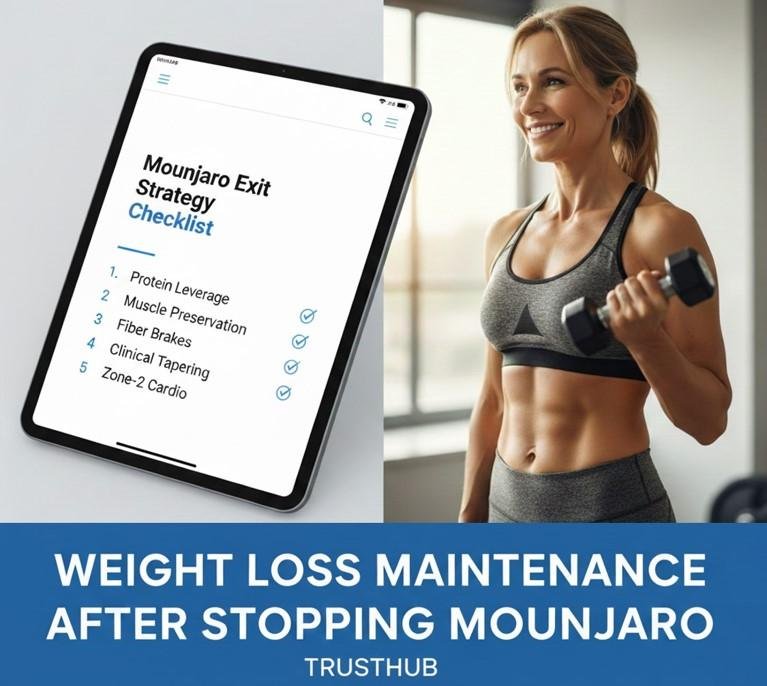
- Protein Leverage: 30–40g of protein within 60 minutes of waking.
- Muscle Preservation: 3x weekly heavy resistance training.
- Fiber brakes: 5–10g of fiber before your largest meal.
- Tapering: Clinician-led dose spacing (10–14 days).
- Zone-2 Cardio: 150 minutes of weekly aerobic fat oxidation.